
Engineered for Precision. Built for Trust.
Custom Wire EDM Services
Wire EDM cuts conductive metal with a thin, electrically charged wire instead of a cutter — so hardened tool steel, thin walls and sharp internal corners come off the machine with no cutting force and no distortion. It is the natural next step when a part needs geometry that milling cannot reach.
What Is Wire EDM?
Wire EDM (electrical discharge machining) removes metal with sparks instead of a cutter. A thin wire, continuously fed under tension, erodes the workpiece along a programmed path while the part sits in a dielectric fluid. The wire never touches the part with force — there is nothing to deflect, nothing to work-harden, and no cutter to break.
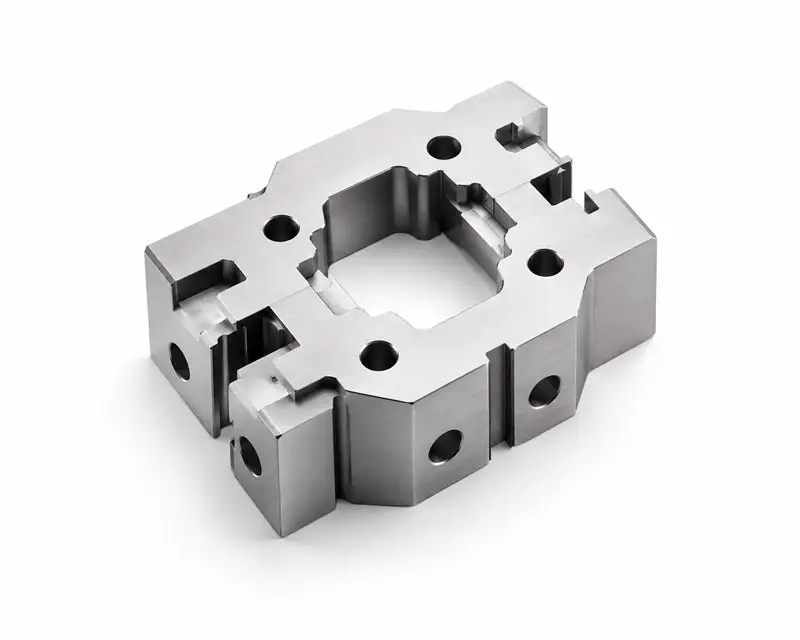
Wire EDM Processes We Offer
Wire cutting handles the flat contours; sinker EDM handles the cavities. Between the two, most of the geometry that machining cannot reach is covered — and when a job calls for more than one process, it is quoted as one order rather than split across suppliers.
Wire EDM Cutting
The standard cut: a wire follows a programmed path straight through the part in two axes. Used for punches, dies, inserts, plates and fixtures — any flat profile where the edges have to come out clean, square and burr-free without a second operation.
Tapered & 4-Axis Cutting
The upper and lower wire guides move independently, so the cut can be tilted as it travels. That produces draft angles and relief on dies and molds, and lets one cut leave a different profile at the top and the bottom of a part.
Small Hole EDM Drilling
A tubular electrode burns a start hole through material that a twist drill cannot touch — hardened steel, or a surface where drilling would walk. It is also used for deep, small-diameter holes and cooling channels, and it is usually the first step before an internal contour can be wired.
Sinker EDM (Die-Sinking)
A shaped electrode burns a three-dimensional cavity into the part, working in steps as it descends. This is how blind pockets, ribs and sharp-bottomed corners are formed in hardened tool steel — geometry a wire cannot reach and a cutter cannot leave.
Fine Wire & Small Features
A thinner wire follows tighter radii and reaches into narrow slots, fine details and closely spaced features that a standard wire cannot enter. It is the option for small parts where the profile itself is the difficult part of the job.
Skim & Finishing Passes
The first cut is rough and leaves a thin recast layer behind. Successive low-power passes strip that layer back and leave a cleaner, more uniform face — which matters on die surfaces, sliding fits and any part going into service under load.
Send Us Your Wire EDM Job
Send the part file or the drawing, along with the material and the heat treatment callout. Our engineers will review where the start hole goes, which process the profile needs and what order the operations run in — then come back within 24–48 hours with a recommendation and a quote, not just a price.
Our Partners








FAQs
Our team is ready to help you
with your project.
WhatsApp Us
+86 15013704953
Email Us
major_p@hanstarmold.com
Call Us
+86 15013704953
Working Hours
Mon-Fri 09:00 - 18:00 (GMT+8)
What is wire EDM used for?
Wire EDM is used for through-cuts and flat profiles in conductive metal — punches, dies, inserts, plates, fixtures and prototype parts with sharp internal corners. It is most often chosen when the material is already hardened, when the walls are thin enough that milling would push them out of shape, or when the profile has details a cutter cannot reach.
Can wire EDM cut hardened steel?
Yes, and that is one of the main reasons to use it. Wire EDM removes material thermally instead of mechanically, so it cuts material that has already been hardened and tempered. A die or punch can therefore be finished to its final geometry after heat treatment, instead of being cut soft and risking movement in the furnace.
What materials can be cut on a wire EDM?
Any metal that conducts electricity: tool steel including hardened grades, stainless steel, aluminum, copper, brass, titanium, nickel alloys such as Inconel, and carbide. Non-conductive materials such as plastics, ceramics and most composites cannot be wire cut — tell us the material and we will point you to the right process.
Wire EDM or CNC milling — how do I choose?
If the part is a 3D shape, if most of the material has to come off, or if the material is still soft, CNC milling does the job. Wire EDM is the better fit for through-profiles, for material that is already hardened, for thin walls and sharp internal corners, and for details a rotating cutter cannot reach. Many parts use both, in sequence.
Does wire EDM leave a heat-affected zone?
Yes. The cut surface carries a thin recast layer left by the sparks, and it is removed with successive low-power skim passes or a light finishing operation. If a cut face is critical — a sliding fit, a sealing face or a fatigue-loaded part — say so on the drawing and it will be planned for.
Can you combine wire EDM with CNC machining in one order?
Yes, and that is usually the cheapest way to do it. We machine the part, drill or burn the start hole, send it for heat treatment if the drawing calls for it, then cut the profile on the wire. One order, one point of contact, no shipping parts between suppliers.