
When choosing aluminum for a CNC-machined part, 6061 and 7075 aluminum are two of the most common options. Both alloys are lightweight, readily available, and well suited to precision cnc machining. But they are designed for different performance requirements.
The main difference is straightforward: 7075 offers significantly higher strength, while 6061 provides better corrosion resistance, weldability, anodizing consistency, and lower material cost.
So which one should you use?
It depends on what the part needs to do. Strength-to-weight ratio, operating environment, finishing requirements, fabrication method, and overall cost all need to be considered before selecting the alloy.
This guide compares 6061 vs. 7075 aluminum from a CNC machining perspective and explains where each alloy makes the most sense.
6061 vs. 7075 Aluminum at a Glance
The values below are representative of common T6/T651 tempers. Actual mechanical properties depend on the specific material specification, temper, product form, and supplier certification.
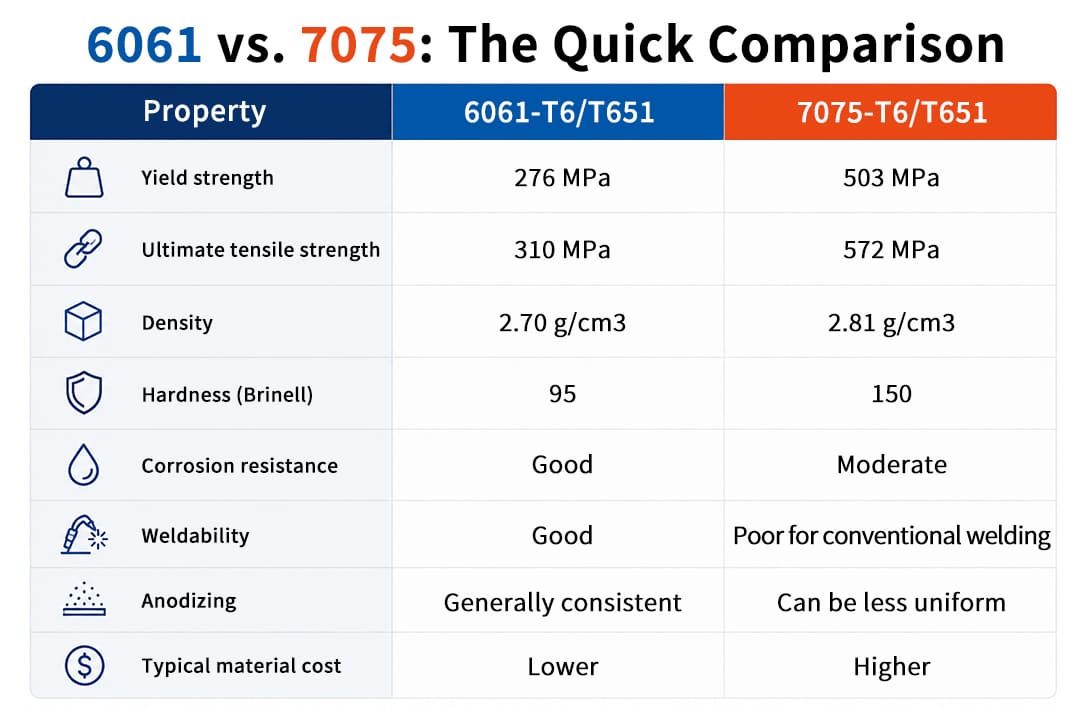
The most important takeaway is that 7075 provides substantially higher strength with only a small increase in weight, while 6061 is generally easier and more economical to work with.
Strength-to-Weight Ratio: 7075 Has the Advantage
The biggest reason engineers choose 7075 aluminum is its strength.
In the T6 condition, 7075 has a yield strength of around 503 MPa, compared with approximately 276 MPa for 6061-T6. Its ultimate tensile strength is also significantly higher.
Despite this increase in strength, the density difference is relatively small:
- 6061: approximately 2.70 g/cm³
- 7075: approximately 2.81 g/cm³
That makes 7075 particularly attractive when a component needs to withstand high loads without adding significant weight.
Typical applications include aerospace components, high-load mechanical components, robotics components, UAV parts, and other weight-sensitive applications.
However, higher strength does not automatically make 7075 the better choice.
If a 6061 component already satisfies the required loads, safety factor, fatigue requirements, and dimensional constraints, upgrading to 7075 may add cost without providing a meaningful performance benefit.
Corrosion Resistance: 6061 Is Easier to Protect
6061 aluminum generally offers better corrosion resistance than 7075, making it a practical choice for outdoor, humid, and marine-adjacent environments.
7075 contains a higher proportion of zinc and other alloying elements that contribute to its high strength but make it more susceptible to certain forms of corrosion. Under specific conditions, particularly sustained tensile stress in a corrosive environment, some 7075 tempers can also be susceptible to stress-corrosion cracking.
For demanding environments, 7075 components may require additional corrosion protection, such as anodizing, conversion coating, primer, or paint, depending on the application and specification.
For applications where corrosion resistance is important but the extreme strength of 7075 is not required, 6061 is often the simpler material choice.
Weldability: 6061 Is the Clear Choice
If a component needs to be welded, 6061 is generally the preferred alloy.
6061 can be welded using conventional aluminum welding processes, although welding still reduces strength in the heat-affected zone and may require appropriate post-weld treatment depending on the application.
7075, on the other hand, is difficult to weld because of its susceptibility to hot cracking and significant loss of mechanical properties in and around the weld zone.
For welded structures, assemblies, and fabricated components, 6061 is therefore usually a much more practical choice.
CNC Machinability and Surface Finish
Both 6061 and 7075 are considered highly machinable aluminum alloys, which is one reason they are widely used for CNC milling and turning.
For complex aluminum components with multiple angled features or difficult tool access, 5-axis CNC machining can reduce setups and improve access to critical features.
6061 is generally forgiving during machining and works well across a broad range of cutting conditions. It offers predictable chip formation, relatively low tool wear, and efficient cycle times.
7075 also machines very well, but its higher hardness and strength can place greater demands on cutting tools and machining parameters. Tool selection, cutting speed, feed rate, coolant strategy, and workholding all need to be matched to the part geometry and production requirements.
For both alloys, the final machining result depends on more than the material itself. Part geometry, tolerances, tool access, workholding, surface-finish requirements, and machine capability can have a much greater effect on machining cost and quality.
Anodizing: Material Selection Can Affect Appearance
If the finished component will be anodized, the choice between 6061 and 7075 deserves additional consideration.
6061 generally provides a more consistent anodized appearance and is widely used for components where both corrosion protection and surface appearance matter.
7075 can also be anodized, but its alloy composition can make color consistency and appearance more difficult to control, particularly for decorative or color-matched finishes.
If appearance is a critical requirement, it is worth discussing the alloy, anodizing process, color specification, and sample approval with the machining and finishing supplier before production begins.
Cost: 6061 Is Usually More Economical
Material cost is another significant difference between the two alloys.
7075 aluminum typically costs more than 6061, and the difference can become substantial in larger production runs or when the part requires a significant amount of raw material.
Machining cost can also differ depending on the component. Cutting parameters, tool wear, geometry, tolerances, setup requirements, and production volume all affect the final CNC machining cost.
For applications where 6061 already provides sufficient mechanical performance, choosing it can reduce material and manufacturing costs without compromising the function of the part.
For high-performance applications where the additional strength of 7075 enables a lighter or more compact design, the higher material cost may be justified.
When Should You Use 6061 Aluminum?
6061 is a strong general-purpose choice for CNC-machined aluminum components.
Consider 6061 when:
- The component needs to be welded
- Corrosion resistance is important
- A consistent anodized appearance is required
- Material cost is a major consideration
- The required strength can be achieved with 6061
- The component is a general structural or mechanical part
- Ease of machining and finishing are priorities
Common 6061 CNC machining applications include:
- Housings and enclosures
- Brackets
- Manifolds
- Frames
- Fixtures
- Mounting components
- General structural components
- Machine components
For many standard CNC applications, 6061 is the practical starting point.
When Does 7075 Aluminum Make More Sense?
Choose 7075 aluminum when high strength and low weight are more important than material cost, weldability, or maximum corrosion resistance.
Typical applications include:
- Aerospace structural components
- High-load mechanical components
- Robotics links and arms
- UAV components
- High-performance sporting equipment
- Weight-critical brackets and housings
- Components exposed to high mechanical loads
The key is not simply choosing the stronger alloy. 7075 makes sense when its higher strength provides a measurable engineering advantage.
If the design can meet its requirements with 6061, there may be little reason to pay for the additional strength.
Don’t Overlook the Temper
The alloy designation alone does not completely define the material.
For CNC-machined components, 6061-T6, 6061-T651, 7075-T6, and 7075-T651 can have different properties and machining behavior.
T6 generally indicates solution heat treatment followed by artificial aging. T651 adds stress-relief by controlled stretching, which can help reduce residual stress and dimensional movement during machining.
For applications where stress-corrosion resistance is a concern, 7075-T73 or 7075-T7351 may be considered. These tempers provide improved resistance to stress-corrosion cracking compared with 7075-T6, although with lower strength.
For this reason, a material specification should identify both the alloy and temper, rather than simply stating “6061 aluminum” or “7075 aluminum.”
3 Common Mistakes When Choosing Between 6061 and 7075
1. Ignoring the Operating Environment
Selecting 7075 solely for its higher strength can create problems if the component will operate in a corrosive environment under sustained tensile stress.
Consider the operating environment, loading conditions, required corrosion protection, and material temper before finalizing the specification.
2. Changing the Alloy Late in Development
Switching from 6061 to 7075 after the design has already been validated can affect more than material cost.
The change may influence:
- Mechanical performance
- Fatigue behavior
- Corrosion protection
- Anodizing and surface appearance
- Machining parameters
- Dimensional stability
- Material certification
- Overall production cost
Material selection should therefore be addressed during the DFM and engineering review, rather than after the design is already locked.
3. Assuming Material Is the Only Machining Cost Driver
It is easy to focus on the price difference between 6061 and 7075 and overlook the larger cost drivers in CNC manufacturing.
Actual machining cost depends heavily on:
- Part geometry
- Dimensional tolerances
- Surface-finish requirements
- Tool access
- Number of setups
- Workholding
- Material removal rate
- Production volume
- Inspection requirements
In some cases, the material is not the main problem. A difficult part design can have a much greater impact on machining cost than the difference between two aluminum alloys.
6061 vs. 7075: Which Should You Choose?
There is no universal winner between 6061 and 7075 aluminum.
Choose 6061 when you need a cost-effective, corrosion-resistant, weldable alloy with consistent finishing characteristics.
Choose 7075 when the application demands significantly higher strength and a high strength-to-weight ratio.
A simple way to think about it:
6061 = versatility, corrosion resistance, weldability, and cost efficiency
7075 = higher strength, lower weight for a given strength requirement, and high-performance applications
The best choice is the alloy that meets the actual engineering requirements without adding unnecessary cost or manufacturing complexity.
Need Help Selecting the Right Aluminum Alloy?
Material selection is easier when it is evaluated together with the part design and manufacturing process.
At Hanstar, we provide CNC machining services for both 6061 and 7075 aluminum for aerospace, automotive, robotics, medical, and industrial applications. Our engineers can review your CAD geometry, loading requirements, operating environment, tolerances, surface finish, and production volume to help determine the appropriate alloy and temper.
For certified applications, we also maintain material traceability and inspection records throughout the manufacturing process.
If you’re deciding between 6061 vs. 7075 aluminum for a CNC-machined component, send us your CAD file and drawing. We can review the design and recommend the material specification before production begins.