Moving from prototypes to production presents cost challenges. Rapid prototyping can be expensive for repeated small orders, while conventional high-volume molding requires substantial tooling investment. Low-volume injection molding can bridge this gap by providing molded parts for smaller production runs, with tooling options and order quantities that can be tailored to project requirements.
How Do You Select the Right Tooling Option for Low-Volume Production?
Selecting a tooling strategy dictates capital expenditure and lead times. Partnering with an experienced custom plastic parts manufacturer, aluminum tooling is often considered for prototypes and short production runs because it can be machined relatively quickly and may require a lower initial tooling investment. Its high thermal conductivity can support heat transfer during cooling.
However, aluminum generally has lower wear resistance than tool steel, so its suitability for glass-fiber-reinforced or other abrasive resins should be evaluated according to the reinforcement content, expected shot count, and mold design.
The table below outlines how common tooling materials compare across key performance parameters for bridge production:
| Tooling Material | Machining Speed | Thermal Conductivity | Best Suited Applications |
| 7075-T6 Aluminum | Very High | Excellent | Prototypes and short runs with less abrasive resins |
| P20 Pre-hardened Steel | Moderate | Medium | General-purpose and selected engineering resins for low-to-medium volume production |
| H13 Tool Steel | Low | Low | High-temperature and wear-intensive applications |
Aluminum Molds
Aluminum tooling is often considered for prototypes and short production runs because it can be machined relatively quickly and may require a lower initial tooling investment. Its high thermal conductivity can support heat transfer during cooling.
Low-Volume Injection Molding: Tooling Options, Cost Drivers, and Design Checklist
Moving from prototypes to production presents cost challenges. Rapid prototyping can be expensive for repeated small orders, while conventional high-volume molding requires substantial tooling investment. Low-volume injection molding can bridge this gap by providing molded parts for smaller production runs, with tooling options and order quantities that can be tailored to project requirements.
How Do You Select the Right Tooling Option for Low-Volume Production?
Selecting a tooling strategy dictates capital expenditure and lead times.
The table below outlines how common tooling materials compare across key performance parameters for bridge production:
| Tooling Material | Machining Speed | Thermal Conductivity | Best Suited Applications |
| 7075-T6 Aluminum | Very High | Excellent | Prototypes and short runs with less abrasive resins |
| P20 Pre-hardened Steel | Moderate | Medium | General-purpose and selected engineering resins for low-to-medium volume production |
| H13 Tool Steel | Low | Low | High-temperature and wear-intensive applications |
Aluminum Molds
Aluminum tooling is often considered for prototypes and short production runs because it can be machined relatively quickly and may require a lower initial tooling investment. Its high thermal conductivity can support heat transfer during cooling.
However, aluminum generally has lower wear resistance than tool steel, so its suitability for glass-fiber-reinforced or other abrasive resins should be evaluated according to the reinforcement content, expected shot count, and mold design.
Soft Steel Molds
P20 pre-hardened steel offers a balance between tooling cost and durability for prototype and low-to-medium volume production. It provides greater wear resistance than aluminum, but its suitability for abrasive resins depends on reinforcement content and production requirements. More wear-resistant tool steels may be preferable for highly abrasive applications.
Hardened Steel Molds
Hardened tool steels provide greater wear resistance for demanding molding applications and longer production runs. H13 is a hot-work tool steel suitable for applications involving elevated mold temperatures and abrasive material flow. Its performance depends on heat treatment, mold design, and processing conditions.
What Key Cost Drivers Influence an Injection Molding Quote?
Every tooling quote reflects the geometric complexity of your design, resin characteristics, and post-processing requirements. Understanding these variables allows design engineers to optimize models before submitting requests for an injection molding quote.
Mold Tooling Complexity
Complex geometries requiring undercuts, side-action cores, or complex lifters increase mold fabrication labor. Each additional moving component can increase mold design, machining, fitting, and maintenance requirements. Depending on the geometry and material, manufacturing these features may involve CNC machining, electrical discharge machining (EDM), or other precision processes.
Simplifying outer profiles and relocating internal snaps eliminates side-action mechanisms, reducing overall mold complexity.
Resin Selection and Additives
Standard commodity polymers like ABS and polypropylene process cleanly at lower melt temperatures and moderate injection pressures. Specialized engineering resins like PEEK, PPS, or glass-fiber reinforced compounds require hardened mold cavities and precise thermal control. High-performance polymers increase raw material expenses and require specialized machine setups.
Secondary Operations and Finishing
Secondary operations such as SPI/VDI texturing, pad printing, and laser engraving can increase post-molding costs. Assembly processes such as ultrasonic welding may add further labor and equipment requirements when multiple molded components need to be joined. Specifying a molded-in texture to your SPI/VDI grade keeps piece-part processing costs low; high-polish or bead-blasted finishes add a separate tooling step.
Why Choose Hanstar Technologies as Your Custom Plastic Parts Manufacturer?
Hanstar Technologies Co., Ltd. provides tooling and molding services for B2B clients in aerospace, automotive, medical devices and robotics.
In-House Tooling Precision
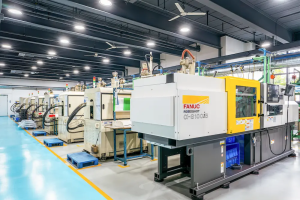
Hanstar operates an in-house mold shop that produces more than 300 molds annually, with mold-tool machining precision of 0.005 mm. Its injection molding equipment includes 11 machines from 60 to 600 tons, including all-electric FANUC ROBOSHOT cells with a stated machine precision of ±0.01 mm. The 0.005 mm figure describes mold-tool machining accuracy, not a finished-part tolerance: our typical molded-part tolerance is ±0.02 mm, with tighter control possible on critical dimensions depending on resin, part geometry and measurement conditions. The ±0.01 mm FANUC value is a machine rating and the 0.001 mm CMM value is instrument resolution; neither is a molded-part tolerance.
Certified Quality Management
Manufacturing quality is supported by ISO9001, ISO13485, IATF16949, and AS9100D certifications. Dimensional verification uses Zeiss Coordinate Measuring Machines with 0.001 mm resolution. Raw material inspection reports are available for each order.
End-to-End Scalability
From prototype validation to low-volume runs, Hanstar offers complete custom injection molding services with no minimum order quantity for prototype and low-volume projects. Requirements for larger production runs depend on tooling and project specifications.
How Do You Optimize Custom Plastic Parts for Manufacturability?
Adhering to strict Design for Manufacturability (DFM) rules prevents common molding defects such as sink marks, voiding, warpage, and short shots during low volume injection molding.
Uniform Wall Thickness
Thick wall sections cool more slowly than adjacent thin sections, pulling material inward and causing surface depression. When additional structural strength is required, consider using internal ribs rather than increasing the thickness of entire sections. Rib dimensions should be designed in relation to the nominal wall thickness and the selected resin’s shrinkage behavior. Proper rib proportions can provide structural support while helping limit material accumulation, uneven cooling, and sink marks.
Adequate Draft Angles
Without sufficient draft angle, parts bind against cavity walls during the ejection stroke. The required draft angle varies across different mold features. Core pins and deep vertical ribs should be designed with sufficient clearance and draft to facilitate ejection and reduce the risk of drag marks or part deformation.
Undercut Avoidance
Features that are not aligned with the mold’s draw direction become undercuts and prevent straightforward part ejection. Where part function allows, redesigning undercuts as pass-through openings or features aligned with the mold’s draw direction may simplify tooling. However, some geometries still require side actions or lifters, depending on the parting line and ejection direction.
- Wall thickness: Mark the nominal wall and every thickness transition on the released drawing before tooling review.
- Draft: State the draft angle for each face, including the additional allowance on textured surface
- Radii: Add radii to sharp internal corners and check that rib intersections do not create thick sections.
- Undercuts: List every feature outside the draw direction and record the agreed slide, lifter or redesign decision.
Conclusion
Successful low-volume injection molding depends on choosing the right tooling material, controlling production costs, and optimizing part designs before manufacturing begins. Early DFM reviews, appropriate mold material selection, and reliable quality inspection help engineering teams reduce production risks while maintaining consistent part quality.
For businesses looking to move from prototyping to low-volume production, working with an experienced manufacturing partner can simplify the transition. Hanstar Technologies provides custom injection molding services to support projects from prototype validation to low-volume production, helping customers address tooling and manufacturing requirements.