Complex engineering parts can expose weaknesses that remain hidden on simple components. Deep cavities, compound angles, curved surfaces, and features distributed across several faces place different demands on equipment, programming, inspection, and communication.
We at Hanstar Technologies understand that selecting a 5 axis CNC machining supplier involves more than checking whether a factory owns multi-axis equipment; engineering teams also need to examine how the supplier handles technical review, materials, quality requirements, and the transition from early prototypes to production.
Examine Experience With Complex Geometry
A supplier’s experience should be assessed through the types of geometries it routinely handles rather than through machine counts alone. Aerospace structures, robotic joints, medical mechanisms, and advanced-equipment components can contain angled surfaces, intersecting features, thin sections, and difficult tool-access areas that require careful process planning.
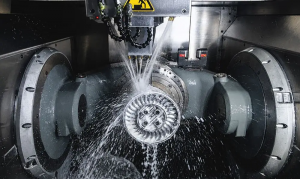
Five-axis capability can allow the cutter to approach several surfaces from different orientations without repeatedly removing and repositioning the workpiece. Compared with conventional 3-axis machining, this may reduce certain setup-related alignment issues and provide more practical access to compound features.
The drawing itself offers useful evidence during a technical discussion. Ask how the supplier would approach difficult surfaces, datum relationships, workholding, tooling access, and critical dimensions. A thoughtful response can reveal considerably more about manufacturing experience than a generic capability list.
Look Beyond Machine Capability
Machine configuration is only one part of the manufacturing equation. Engineering review, CAM programming, fixture design, cutting-tool selection, and operator experience all influence how multi-axis equipment is applied to an actual component.
Material behavior deserves equal attention. Aluminum, stainless steel, titanium, engineering plastics, and hardened materials can respond differently to cutting forces, heat, vibration, and tool wear. A supplier should be able to discuss how the selected material interacts with the part geometry and proposed machining strategy.
For aerospace and robotics teams, these discussions can become particularly important when components combine tight dimensional requirements with lightweight structures or intricate surfaces. The suitability of 5 axis CNC machining services should be evaluated against the specific material, geometry, tolerance, and production conditions rather than treated as a universal solution.
Review Inspection Planning Before Production
Precision machining does not end when the cutter leaves the workpiece. Inspection planning should begin with the drawing and identify which dimensions, geometric relationships, and surface characteristics require verification.
Different features may call for different measurement methods. Basic dimensions might be checked with conventional precision instruments, while complex profiles, positional relationships, or multiple datums may require coordinate measurement or other specialized equipment. The inspection method should correspond to the characteristic being evaluated.
Prototype projects also provide an opportunity to examine how quality information is communicated. First-article measurements, material documentation, dimensional reports, and records for critical characteristics can help engineering teams understand whether the manufacturing process is producing the intended result.
A capable 5 axis CNC machining supplier should be able to discuss inspection requirements before production rather than treating quality documentation as an afterthought.
Evaluate Communication And Production Continuity
Communication becomes particularly important when engineering projects move through several revisions. A prototype may reveal design changes, tolerance adjustments, or manufacturing constraints that need to be incorporated into subsequent batches.
A supplier should have a practical method for handling drawing revisions, technical questions, approvals, and feedback. Clear communication also reduces the risk that engineering intent becomes diluted as information passes between procurement, design, quality, and production teams.
Prototype-to-production continuity is another useful consideration. A manufacturing route that works for one prototype does not automatically remain appropriate for larger quantities. Tooling, fixtures, cycle times, inspection frequency, and material purchasing may all need to evolve as production requirements change.
For advanced-equipment developers, continuity can matter just as much as initial machining capability.
Match Supplier Capabilities To Project Requirements
Supplier evaluation becomes more meaningful when engineering teams compare specific project needs rather than relying on a single capability label. Aerospace components may place strong emphasis on documentation and traceability, robotic parts can involve multi-sided mechanical interfaces, while advanced equipment may require unusual combinations of materials, tolerances, and surface treatments.
At Hanstar Technologies, we support metal and plastic component production through CNC milling, CNC turning, mill-turn machining, surface grinding, and surface finishing. Our equipment includes imported 3-axis, 4-axis, and 5-axis CNC machining centers, CNC lathes, and precision grinding equipment. For projects requiring 5 axis CNC machining services, we consider the drawing, material, geometry, inspection requirements, and intended production stage together rather than evaluating the machine process in isolation.
The same review can be useful before a prototype enters production. Questions about fixture strategy, critical features, inspection scope, revision control, and future quantities can reveal whether the proposed manufacturing route remains practical as project requirements develop.
Hanstar Technologies combines multi-axis machining capabilities with experience across different CNC processes for custom metal and plastic components. If your aerospace, robotics, or advanced-equipment project involves complex geometry, share the drawings and technical requirements with us to discuss a suitable machining approach.