CNC Machining vs. 3D Printing: Which Is Right for Your Part?
If your part requires tight tolerances, production-grade metal materials, or a controlled surface finish, CNC machining is generally the better fit. If the priority is rapid prototyping, design iteration, or producing certain highly complex geometries without tooling, 3D printing may be more suitable.
The right choice depends on the part rather than the manufacturing method alone. Tolerance requirements, material, geometry, surface finish, quantity, and intended use should all be considered before selecting a process.
For functional components that will be used in mechanical assemblies or demanding applications, CNC machining can provide predictable dimensional accuracy and a broad choice of engineering materials. For early-stage prototypes or designs that are difficult to manufacture conventionally, 3D printing can offer greater design flexibility.
Key Takeaways
- Choose CNC machining when tight tolerances, precise mating features, or production-grade materials are important.
- Choose 3D printing when rapid prototyping, design iteration, or certain complex geometries are the priority.
- Surface finish and dimensional requirements can make CNC machining more suitable for functional parts.
- Production volume matters: the most economical process can change as quantities increase.
- Part geometry alone does not determine the process. Material, tolerance, finish, and application requirements should be evaluated together.
CNC Machining vs. 3D Printing at a Glance
| Factor | CNC Machining | 3D Printing |
|---|---|---|
| Process | Material is removed from a solid workpiece | Material is built layer by layer |
| Accuracy | Generally high | Depends on printing technology |
| Materials | Wide range of metals and engineering plastics | Depends on printing technology |
| Surface finish | Generally smooth and consistent | Often requires post-processing |
| Complex geometry | Strong capability with multi-axis machining | Strong for certain complex structures |
| Prototyping | Suitable for functional prototypes | Well suited to rapid prototypes |
| Production | Prototype to low- and medium-volume production | Mainly prototypes and selected low-volume applications |
| Dedicated tooling | Usually not required | Not required |
Accuracy and Tolerances
Dimensional requirements are one of the most important factors when choosing between the two processes.
CNC machining is well suited to parts with tight tolerances, precise hole locations, threads, mating surfaces, and other critical dimensions. Because material is removed using controlled cutting operations, the process can provide consistent dimensions when the machine, tooling, material, and machining strategy are properly selected.
3D printing can produce accurate parts, but achievable tolerances vary considerably between technologies and materials. Printed parts may also be affected by factors such as layer height, build orientation, shrinkage, and post-processing.
If a component needs to fit directly into a precision mechanical assembly, CNC machining is often the more straightforward option.
Materials and Part Performance
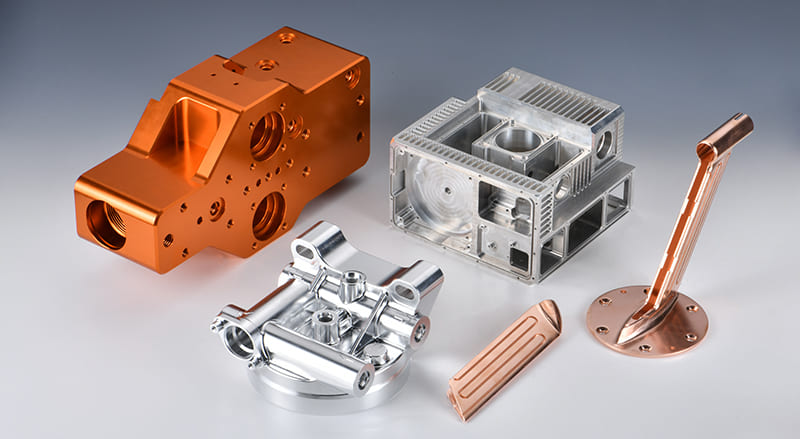
CNC machining supports a broad range of engineering materials, including aluminum, stainless steel, alloy steel, titanium, brass, copper, and engineering plastics.
This makes it suitable for components that require specific mechanical properties, dimensional stability, wear resistance, or resistance to heat and chemicals.
3D printing offers a different range of material options depending on the technology used. Plastics, resins, composites, and certain metals are available, but material selection is more closely tied to the printing process.
For a production component that must meet specific material and performance requirements, confirm the available material options before selecting the manufacturing method.
Geometry and Design Constraints
3D printing can be advantageous for certain geometries that are difficult or expensive to machine. Internal structures, lattice features, and some highly organic shapes can be produced without conventional tooling.
That does not mean complex parts automatically require 3D printing.
Modern CNC machining, particularly five-axis machining, can produce complex contoured components and features across multiple surfaces while reducing the number of setups required. The key question is whether the required geometry can be reached efficiently with the available machine configuration and tooling.
For many precision mechanical components, a complex external shape is still well suited to CNC machining.
Surface Finish and Post-Processing
Surface requirements can also influence the decision.
CNC machining generally produces a more uniform surface directly from the manufacturing process. Machining parameters, cutting tools, and material selection can be adjusted according to the required finish.
Additional processes can be applied when required, including anodizing, electropolishing, polishing, brushing, and other surface treatments.
3D-printed parts often retain visible layer lines and may require additional finishing to achieve the desired appearance or functional surface. The amount of post-processing depends on the printing technology, material, geometry, and application.
If surface quality is a critical requirement, include the required finish in the manufacturing specification rather than evaluating the basic process alone.
Cost and Production Volume
There is no universal rule that CNC machining or 3D printing is always cheaper.
For CNC machining, cost is influenced by factors such as material, machining time, part complexity, number of setups, tolerances, finishing requirements, and quantity.
3D printing can be cost-effective for prototypes and certain low-volume parts because production can begin directly from a digital model without dedicated tooling. However, printing time, material consumption, support structures, and post-processing can increase the cost as part size or quantity increases.
For production quantities, compare the complete manufacturing cost rather than the machine or print cost alone. Depending on the part and material, CNC machining may provide a better balance of cost, consistency, and performance.
Which Process Fits Your Part?
CNC Machining Is Often the Better Choice When You Need:
- Tight dimensional tolerances
- Precise holes, threads, or mating features
- Production-grade metals or engineering plastics
- Consistent and repeatable dimensions
- Controlled surface finishes
- High mechanical strength or durability
- Functional prototypes that need to represent production parts
- Low- to medium-volume production
For complex components with features on multiple surfaces, five-axis CNC machining can provide additional flexibility by allowing multiple surfaces to be machined in fewer setups.
3D Printing May Be the Better Choice When You Need:
- Rapid prototypes
- Frequent design iterations
- Very small quantities
- Certain geometries that are difficult to machine
- Tool-free production during early development
- Lightweight or internally structured designs
The appropriate printing technology should be selected based on the required material properties, accuracy, surface finish, and intended use of the part.
How to Choose Between CNC Machining and 3D Printing
Before sending a part for production, evaluate these requirements:
1. What Material Does the Part Require?
Start with the material specified for the application. If the required material is not suitable for the selected process, the manufacturing method may need to change.
2. What Tolerances Are Critical?
Identify the dimensions that affect assembly, movement, sealing, or other functional requirements.
3. What Surface Finish Is Required?
Specify whether the part needs a particular machined finish or secondary treatment.
4. How Complex Is the Geometry?
Determine whether the features can be reached efficiently using CNC machining or whether additive manufacturing provides a practical advantage.
5. How Many Parts Are Required?
Compare the economics for the actual production quantity rather than assuming that one process is always cheaper.
6. How Will the Part Be Used?
A visual prototype, functional prototype, and production component can have very different manufacturing requirements.
Conclusion
CNC machining and 3D printing are not interchangeable solutions. Each process has advantages for different types of parts.
3D printing is particularly useful for rapid prototyping, design iteration, and certain complex geometries. CNC machining is often the stronger choice when a component requires tight tolerances, a broad choice of engineering materials, controlled surface finishes, and reliable mechanical performance.
The best process should be selected based on the complete part specification: material, tolerance, geometry, surface finish, quantity, and application.
For precision components that require CNC machining, Hanstar’s CNC Machining Services provides CNC milling, turning, and multi-axis machining for prototype and low- to medium-volume production.