Production sourcing becomes more demanding once custom components involve narrow tolerances, difficult materials, or geometries that cannot be handled through a simple machining setup. Engineering and procurement teams need more than a quotation to judge whether a supplier fits the program: drawing interpretation, material knowledge, inspection methods, documentation, and communication all affect the finished result.
Selecting a precision CNC machining manufacturer should consequently involve a review of the entire production process. At Hanstar Technologies, we work with customers by connecting engineering review, CNC manufacturing, and inspection around the requirements defined in their drawings.
Define Tolerance Requirements Before Comparing Suppliers
Not every dimension on a mechanical drawing has the same functional importance. Bearing seats, mating surfaces, alignment features, and sealing areas may require closer control than external dimensions that have little effect on assembly.
Engineering teams can classify critical features before requesting quotations. Such preparation gives suppliers a clearer basis for assessing the machining route and prevents unnecessarily tight tolerances from being applied to areas where they offer little functional benefit.
Consider Geometric Relationships
Dimensional tolerance is only one element of part accuracy. Flatness, perpendicularity, concentricity, positional tolerance, and profile requirements can interact with one another, particularly on components containing multiple datum references.
Complex geometry may also affect how a feature is accessed during machining. Deep cavities, thin walls, angled surfaces, and compound curves can require different tooling or setups even if their numerical tolerances appear similar.
Connect Tolerances With Inspection
The inspection method should reflect the characteristics specified on the drawing. CMM measurement can be useful for establishing relationships between multiple surfaces, while portable measurement equipment can provide flexibility for larger components or areas that are difficult to position on a fixed machine.
Such considerations help sourcing teams distinguish between a supplier that simply quotes an accuracy figure and one that has a defined method for verifying the required features.
Assess Material Scope And Process Compatibility
Material selection affects cutting forces, heat generation, tool wear, dimensional stability, and surface quality. Aluminum alloys, stainless steels, titanium, and engineering plastics each introduce different machining considerations.
A supplier discussion should address the exact grade rather than stopping at a broad category such as “aluminum” or “stainless steel.” Material certificates and traceability may also become relevant where component performance depends on a specified alloy.
Account For Surface Treatment
Machining dimensions can interact with subsequent finishing processes. Anodizing, plating, polishing, heat treatment, and other treatments may alter surface characteristics or dimensions, so these operations should be considered during process planning.
Surface requirements also deserve functional consideration. Corrosion resistance, conductivity, wear behavior, cleanliness, and appearance can call for different finishing routes, depending on the component’s application.
Relate Materials To Production Conditions
The most suitable material is not determined by mechanical properties alone. Availability, machinability, finishing compatibility, production quantity, and operating environment can all influence the practical manufacturing route.
For procurement teams, discussing these factors early can reveal whether the proposed material and process combination makes sense before the project moves into production.
Review Prototype-To-Production Capability
Prototype production offers an opportunity to examine more than physical dimensions. Engineers can review tool access, wall thickness, surface finish, assembly interfaces, and other characteristics that may affect later manufacturing.
Feedback from this stage can also expose drawing details that require clarification. Resolving such questions before larger quantities are released is generally more practical than discovering them after production has begun.
Examine Revision Management
Production programs rarely remain static. CAD models may be updated, tolerances revised, materials changed, or finishing requirements modified as the product develops.
A supplier should have a clear way to distinguish current drawings from superseded versions. Consistent document control gives engineering and purchasing teams a shared reference when multiple production orders are placed over time.
The machining strategy used for several prototypes may not suit a larger order. Fixtures, tooling, machine selection, inspection frequency, and production sequencing can all change as quantities increase.
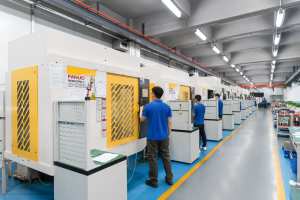
Our precision parts manufacturer services cover prototypes, small-batch work, and production orders, with CNC milling, turning, 5-axis machining, grinding, and finishing available according to the part requirements.
Examine Quality Documentation And Communication
Inspection documentation should provide information that engineers can actually evaluate. Depending on the project, this may include dimensional inspection reports, first article inspection records, certificates of conformity, or material documentation.
The value of these records lies in traceability. If a dimensional question appears during assembly, documented inspection results give the customer and supplier a common technical reference for investigating the issue.
Compare Suppliers Through The Entire Production Chain
A large equipment list does not automatically indicate suitability for a particular component. The more useful question is whether the available machines, tooling, fixtures, materials, and inspection resources correspond with the requirements of the actual drawing.
For example, 5-axis machining can be valuable for components with complex surfaces or multi-face features, while simpler geometries may be handled efficiently through 3-axis or 4-axis processes. Process selection should follow part requirements rather than equipment marketing.
Examine Quality Systems
Certifications can provide useful information about a supplier’s quality-management framework, particularly for customers operating in aerospace, automotive, medical, or other regulated environments. Hanstar lists ISO 9001, IATF 16949, AS9100D, and ISO 13485 among its quality certifications.
These credentials should still be considered alongside practical evidence such as inspection reports, engineering communication, process controls, and the supplier’s ability to work with the customer’s documentation requirements.
Consider Long-Term Collaboration
Custom production programs often involve repeated communication rather than a single transaction. Engineering changes, new part numbers, updated drawings, material questions, and additional inspection requirements can appear throughout the product lifecycle.
A useful supplier assessment should account for how comfortably the manufacturing team can participate in those technical exchanges. Price remains relevant, but the broader evaluation should reflect the effort required to move a component from drawing to repeatable production.
Conclusion
Supplier evaluation becomes more meaningful once the discussion moves beyond quoted tolerances and unit prices. Tolerance interpretation, material compatibility, prototype feedback, revision control, inspection evidence, and technical communication each reveal something different about how a manufacturing partner will handle a custom program.
We at Hanstar Technologies support B2B customers with CNC machining, multi-axis manufacturing, engineering review, and dimensional inspection resources for custom metal and plastic components. If your team is assessing a new production source, send us your drawings and specifications so we can discuss the manufacturing requirements with you.